

Mud daubers in NJ are drawn to properties with damp soil, sheltered nesting surfaces, and spiders to feed their young. That combination makes roof eaves, garages, sheds, and covered porches suitable places for their mud nests. These solitary wasps rarely sting, and most nests are more of a maintenance concern than a safety threat. If you’ve found dried mud tubes or clusters of mud cells around your house, identifying the nest and checking whether it’s occupied will help you decide what to do.
What Attracts Mud Daubers to New Jersey Homes?
Mud daubers need access to building material, protection for their nests, and prey for their developing young. The University of Florida IFAS Extension’s research on black-and-yellow mud daubers identifies mud availability, shelter, and spider prey as important factors in nesting-site selection.
A female may gather mud from one part of a yard, hunt spiders elsewhere, and build her nest beneath a roof overhang. The resources do not all have to be concentrated in one spot.
Damp Soil Supplies the Mud for Nest Construction
Female mud daubers collect small amounts of wet soil, carry them to a sheltered surface, and shape them into chambers. As the mud dries, it forms a hard structure around the developing young.
Common places to check for workable mud include:
- Soil beneath dripping hose connections or outdoor faucets
- Persistent muddy patches near downspouts
- Low areas where rainwater collects
- Poorly draining soil beside garages or sheds
- Damp garden beds close to buildings
A large puddle is not necessary. Even a small patch of moist soil can supply building material.
If mud daubers repeatedly appear around one section of the house, look for nearby leaks or drainage problems. Fixing those conditions may reduce convenient mud sources, although wasps can still collect material from elsewhere.
Roof Overhangs and Covered Corners Offer Shelter
Mud daubers attach their nests to surfaces protected from direct rain. The underside of an eave, a porch ceiling, or an exposed garage rafter can provide the shelter they need.
These spots often remain undisturbed for long periods. A female can complete several mud chambers without the nest being disturbed by ordinary household activity.
The same sheltered corner may attract nesting in different years because the structure continues to offer protection. Finding another nest there does not necessarily mean the previous wasps have returned.
Spiders Provide Food for Their Young
Mud daubers are spider-hunting wasps. A female captures spiders, paralyzes them with her sting, and stores them inside mud chambers. She lays an egg in each provisioned cell, and the developing larva feeds on the spiders.
The black-and-yellow mud dauber can stock an individual cell with numerous spiders before sealing it. Once the chamber is closed, the young wasp develops inside.
Adult mud daubers feed on nectar and may also consume fluids from spider prey. Their spider hunting primarily supports reproduction.
Spider activity around garages, sheds, and covered outdoor spaces can provide hunting opportunities. However, a mud dauber nest does not prove that spiders have established a serious infestation inside the home. The female may collect prey well beyond the nesting surface.
How to Identify Mud Daubers and Their Nests
Mud daubers can be mistaken for yellowjackets or other wasps, particularly when homeowners see a black-and-yellow insect near the roofline. Nest construction and behavior often provide better identification clues than color alone.
What Does a Mud Dauber Look Like?
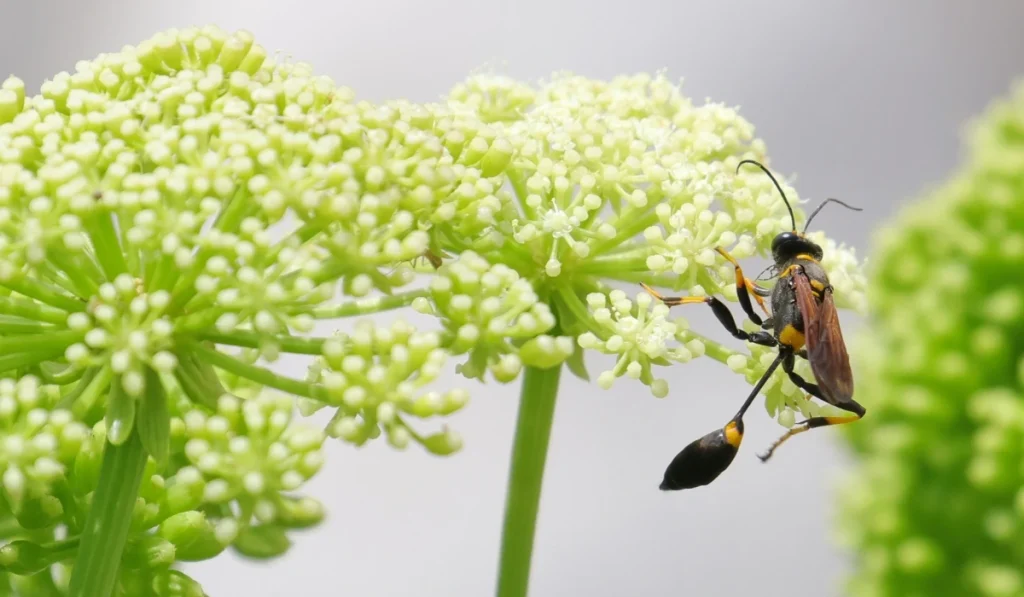
Mud daubers have slender bodies, long legs, and a narrow waist connecting the thorax and abdomen. Their coloring varies among species.
Black-and-yellow mud daubers have dark bodies with yellow markings. Blue mud daubers have a metallic blue or blue-black appearance, while organ-pipe mud daubers are typically dark-bodied.
Unlike yellowjackets and hornets, mud daubers are solitary. A female constructs or provisions her own nest without a colony of workers. Seeing one repeatedly carrying mud beneath an overhang is consistent with nesting activity.
What Do Mud Dauber Nests Look Like?
Mud dauber nests consist of hardened mud, but their shape differs by species.
- Organ-pipe mud daubers build long, narrow mud tubes that resemble a group of small pipes.
- Black-and-yellow mud daubers construct clusters of individual cells, forming irregular or roughly rectangular structures.
- Blue mud daubers may renovate existing mud nests built by other mud dauber species.
An intact nest may have sealed chambers, while an older nest may show small, round openings where adults have emerged.
These mud structures differ from the exposed paper combs built by paper wasps and the enclosed paper nests produced by many social wasps.
How Mud Daubers Differ From Other Wasps
New Jersey properties host several kinds of wasps, and correct identification matters because nesting behavior and sting risk differ.
| Wasp | Typical Nest | Behavior Around the Nest |
| Mud dauber | Mud tubes or clusters of hardened mud cells | Solitary and usually nonaggressive |
| Paper wasp | Exposed paper comb beneath a sheltered surface | Social; may defend the nest |
| Yellowjacket | Enclosed nest underground or inside a cavity | Social; may aggressively defend the colony |
| Cicada killer | Individual burrow excavated in soil | Solitary; females are generally nonaggressive |
For comparison, cicada killer wasps in New Jersey dig burrows in the ground and hunt cicadas, while mud daubers build above-ground mud chambers stocked with spiders.
Watching where an insect enters and leaves is often more useful than trying to identify it from a brief glimpse of its coloring. Keep your distance from unidentified nests, especially when numerous wasps are moving through the same opening.
Where Mud Dauber Nests Appear Around New Jersey Properties
The most likely nesting spots are sheltered surfaces where mud can adhere securely. Homeowners often discover nests during exterior cleaning because the dried mud blends into brick, siding, or unfinished wood.
Eaves, Soffits, and Covered Porches
Roof overhangs are common nesting locations. The underside of an eave provides shelter from rain, while protected corners offer places where mud cells can be attached.
Other areas worth inspecting include porch ceilings, window ledges, recessed siding joints, and spaces behind shutters.
A nest beneath a high roofline may go unnoticed until fall gutter cleaning or another maintenance project. Its presence alone does not mean the wasps pose an immediate danger.
Garages, Sheds, and Outdoor Equipment
Inside garages and sheds, mud daubers may nest along rafters, upper wall corners, and door frames. These surfaces provide shelter without requiring the wasps to enter the living areas of a house.
Outdoor equipment can create additional concerns. Mud daubers sometimes use protected openings in equipment housings, and nests may interfere with mechanical components.
If you discover mud inside a grill, near a burner, or around a ventilation opening, do not operate the equipment until the obstruction has been assessed. An equipment nest calls for more care than one attached to an unused exterior wall.
Are Mud Daubers Dangerous to People or Property?
Mud daubers are capable of stinging, but they are generally docile. Unlike social wasps, they do not maintain large colonies of workers that defend a shared nest.
The University of Maryland Extension’s guidance on mud daubers describes their nonaggressive behavior and advises leaving nests alone when they are not causing a problem.
A female may sting if grabbed, trapped against the skin, or handled roughly. People with serious insect-sting allergies should avoid direct contact with any unidentified wasp.
Can Mud Daubers Damage a House?
Mud daubers attach their nests to existing surfaces. They do not tunnel into wooden siding or framing to create nesting galleries.
Their nests can still leave hardened mud deposits that require cleaning. Removing those deposits carelessly may damage paint or delicate finishes.
A nest inside equipment can also cause problems by obstructing an opening or interfering with a component. In these situations, the location of the nest matters more than the wasp’s tendency to sting.
When Is Leaving a Nest Alone Reasonable?
An isolated nest beneath an unused roof overhang may create no practical problem. If the nest is not near a frequently used entrance, blocking equipment, or exposing someone to unavoidable contact, leaving it undisturbed is often reasonable.
A nest beside a doorway or inside machinery deserves closer assessment because people may accidentally disturb it or because the mud itself may interfere with normal use.
The decision should depend on identification, location, and occupancy rather than the mere presence of a mud nest.
What Happens to Mud Dauber Nests in Fall and Winter?
November is a useful time to inspect the exterior of a New Jersey home, particularly areas where mud nests may have gone unnoticed during summer.
However, cooler weather does not establish that a nest is empty. Some mud daubers spend winter inside sealed chambers before emerging as adults when conditions become favorable.
Sealed Chambers May Still Contain Developing Wasps
Mud daubers develop inside the chambers built and stocked by adult females. After feeding on the stored spiders, immature wasps may remain protected inside the hardened mud through winter.
The University of Nebraska–Lincoln Extension’s guide to bees and wasps around homes discusses their development, seasonal activity, and the reuse of old mud nests by certain species.
A nest can therefore appear inactive in November while still containing living immature wasps. Breaking open sealed chambers may disturb them.
What Do Emergence Holes Tell You?
Small, round holes in a mud nest can show where adults have completed development and left their chambers.
However, a nest may contain both opened and sealed cells. A hole in one section does not prove that every chamber has been vacated.
Some species also reuse or modify older nests. If a nest is not creating a problem and its occupancy is uncertain, leaving it undisturbed is a reasonable option.
How to Prevent Mud Daubers From Nesting Around Your Home
Preventing nesting starts with the conditions that attracted the wasps. The goal is to address avoidable moisture problems, maintain areas where spiders gather, and keep frequently used spaces free of unwanted nests.
Fix Leaks and Persistent Muddy Spots
Check outdoor faucets, hose connections, and downspouts for leaks or drainage problems that keep soil unnecessarily wet.
Where runoff repeatedly creates mud beside a garage or foundation, correct the drainage issue rather than relying on nest removal alone.
Ordinary landscape moisture does not need to be eliminated. Concentrate on persistent problems that also affect the property’s general condition.
Keep Garages and Porches Easy to Inspect
Remove accumulated spider webs from door frames, porch corners, garage rafters, and outdoor storage spaces where practical.
This maintenance makes it easier to notice new mud deposits and may reduce some of the spider activity around frequently used surfaces. It does not eliminate every potential food source because mud daubers can hunt beyond the immediate area.
Keep stored items organized so overhead corners and protected surfaces remain accessible. Repair damaged screens and unnecessary gaps that allow wasps to enter enclosed spaces, but leave required ventilation and drainage openings unobstructed.
Remove Empty Nests Without Damaging Surfaces
Once a nest has been confirmed vacant, mechanical removal may be sufficient. Small deposits of dried mud can often be detached with a suitable tool and cleaned from the surface.
Avoid scraping aggressively against paint, siding, or other finishes. Do not break open sealed chambers if you cannot determine whether they are occupied.
Nests near electrical components, inside equipment, or high above the ground may be better handled by a professional. If a nest is safely out of the way, removal may not be needed at all.
Recheck Previous Nesting Spots in Spring
Before and during the warmer nesting season, inspect locations where you found mud nests previously.
Fresh mud deposits or a female repeatedly carrying mud to one corner may indicate new construction. Finding that activity early allows you to identify the species and decide whether the location warrants attention.
Spring inspection is more useful when paired with ongoing property maintenance. Removing a nest without addressing a persistent leak or an inaccessible storage corner may leave the same conditions in place.
When to Call a Professional for Mud Dauber Activity
Most mud dauber nests do not require emergency treatment. However, professional help may be appropriate when the species is uncertain, the nest is difficult to reach, or mud has accumulated inside equipment.
Repeated nesting beside entrances or in areas where people cannot easily avoid the insects also warrants assessment. Numerous wasps aggressively defending one location may indicate a social species rather than solitary mud daubers.
BHB Pest Elimination serves homeowners in Northern New Jersey. If you’ve found nests near an entrance, inside outdoor equipment, or in an area you cannot safely inspect, contact BHB to request an assessment. Identifying the wasp and evaluating the nest location will help determine whether control is necessary.
Frequently Asked Questions About Mud Daubers in NJ
Do Mud Daubers Return to the Same Nest Every Year?
Some mud dauber species construct new nests, while others may reuse or modify existing mud cells. A protected location may also attract new females in later seasons. Removing an old nest does not make the surface unsuitable for future nesting.
Should I Remove a Mud Dauber Nest in November?
November can be a convenient time to inspect nests, but sealed chambers may contain immature wasps overwintering inside. If you cannot establish that a nest is vacant and it is not causing a problem, leave it undisturbed. Nests interfering with equipment or access areas may require professional assessment.
Do Mud Daubers Sting People?
Female mud daubers can sting, but they are usually nonaggressive and rarely sting unless handled or trapped. They do not defend large colonies like yellowjackets. Avoid handling the insects or disturbing occupied nests, especially if someone nearby has a serious sting allergy.
Will Removing a Mud Dauber Nest Keep Them Away?
Removing an empty nest clears the existing mud structure but does not prevent another wasp from using a suitable location. Repairing persistent leaks, keeping sheltered areas accessible for inspection, and checking previous nesting spots can help manage future activity.