

European hornets are established in New Jersey and can be identified by their large size, reddish-brown and yellow coloring, concealed nesting habits, nighttime activity, and bark-stripping behavior. Understanding those traits helps distinguish Vespa crabro from other large wasps and, more importantly, helps determine whether you are seeing a few foraging workers or activity tied to a nearby nest.
How to Identify a European Hornet
European hornets are true hornets in the genus Vespa. According to Penn State Extension’s European hornet profile, the species was introduced from Europe into North America and was first detected here in the 1840s. It is now widespread and well established across much of the eastern United States.
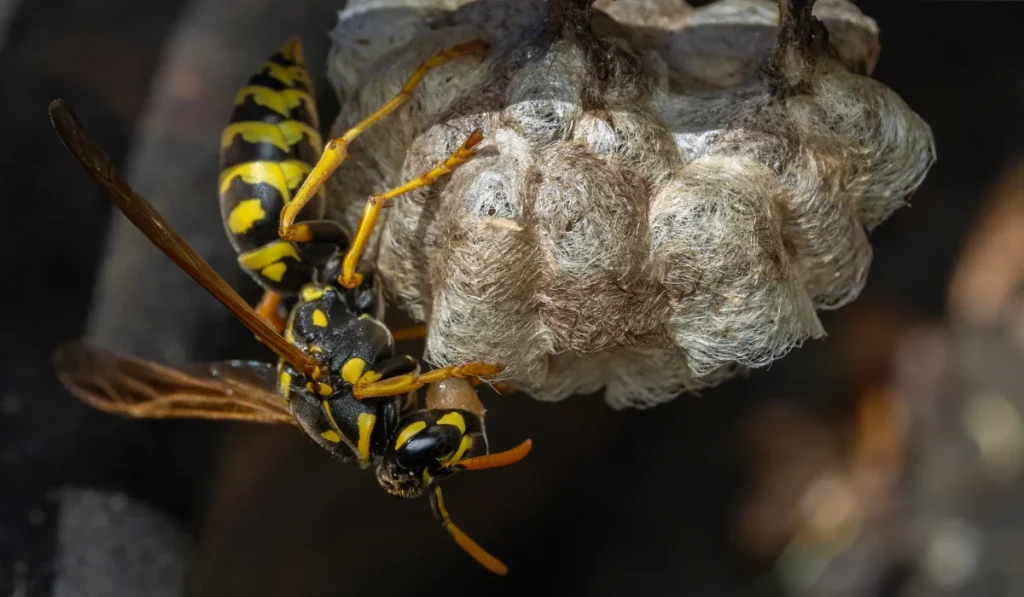
Workers can reach about 25 millimeters, or roughly 1 inch, while queens can reach about 35 millimeters, or approximately 1.3 inches. European hornets have a robust body, reddish-brown coloring on the head and thorax, and a mostly yellow abdomen with darker markings.
Those warmer brown and amber tones help separate them from the sharper black-and-yellow pattern associated with many yellowjackets. Size alone is not enough for a reliable identification, especially because several large wasps occur in New Jersey.
European Hornet vs. Other Large Wasps
Color, nest location, and behavior provide better clues when several large wasps look similar at first glance.
| Insect | Useful Identification Clues | Typical Nesting Pattern |
| European hornet | Large, robust body with reddish-brown and yellow markings; active after dark | Enclosed cavities such as hollow trees and structural voids |
| Bald-faced hornet | Predominantly black with white markings | Exposed gray paper nests in trees, shrubs, and on structures |
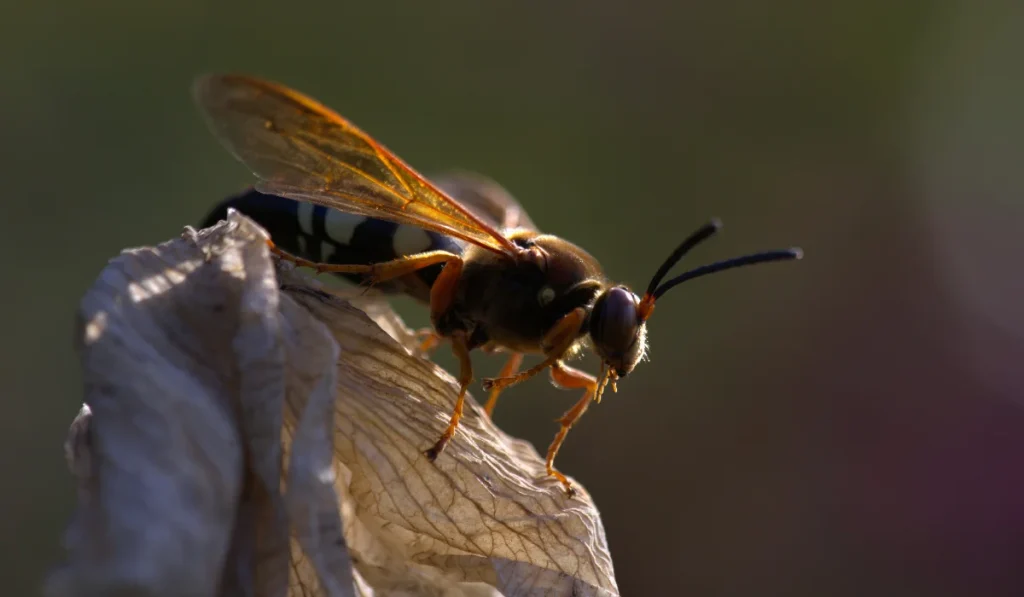
| Cicada killer | Large wasp commonly seen near lawns and bare soil | Individual ground burrows |
| Mud dauber | Slender body with a narrow waist | Small mud nests on sheltered surfaces |
Bald-faced hornets are especially easy to confuse by name. They are actually aerial yellowjackets rather than true hornets, and their exposed paper nests look very different from the concealed cavities European hornets typically use.
Mud daubers differ even more in body shape and nesting behavior. BHB’s overview of mud daubers in New Jersey explains that these solitary wasps have slender bodies and construct nests from mud instead of living in large social colonies.
Where European Hornets Build Nests
European hornet colonies usually develop inside protected cavities, so the nest itself may never be visible. In many cases, repeated worker traffic through one opening is the first useful sign that a colony is nearby.
Hollow Trees
Hollow trees are characteristic nesting sites. A protected trunk or branch cavity gives the developing paper nest shelter while allowing the colony to expand as worker numbers increase.
Repeated traffic matters more than a single sighting. Multiple hornets regularly entering and leaving the same hole in a trunk or large branch can indicate a colony inside.
A hornet simply landing on a tree does not tell you the same thing. European hornets also visit woody plants for sap and bark, which means a tree can function as a feeding site even when the nest is somewhere else.
Wall Voids and Structural Cavities
European hornets can also nest in enclosed spaces in buildings, including wall voids and other protected structural cavities. The visible entrance may be a small exterior gap while the actual nest sits farther inside.
Look for a consistent pattern rather than an occasional hornet near siding or a window. Workers repeatedly entering and leaving the same gap are more suggestive of a structural nest than insects moving randomly around the exterior.
The location becomes more important when that traffic is close to a doorway, deck, walkway, or another area people use regularly.
Why European Hornets Appear Around Lights at Night
European hornets can remain active after sunset, a behavior that helps distinguish them from many other social wasps.
Penn State Extension notes that European hornets forage at night and may be attracted to lights. Workers can circle porch lights, gather around exterior fixtures, or repeatedly fly toward illuminated windows.
That behavior does not mean the nest is attached to the house. Outdoor lighting can attract workers from elsewhere in the area, so nighttime activity around a fixture should be treated as an identification clue rather than proof of a structural colony.
Turning off unnecessary exterior lighting can reduce the concentration of flying insects around doors and windows. It will not, however, resolve an established nest nearby.
Why European Hornets Strip Bark From Trees
Bark damage is another useful sign of European hornet activity in New Jersey, particularly when workers repeatedly return to the same tree or shrub.
According to Rutgers’ New Jersey guidance on European hornets, workers gouge bark and use woody tissue in nest construction while also feeding around sap-producing areas. Rutgers identifies birch, rhododendron, lilac, and dogwood among plants where this activity has been documented.
When Bark Damage Becomes Serious
Localized bark removal may remain limited, but repeated stripping can cause more significant injury when it extends around a branch.
If the damage completely girdles a branch, the conducting tissues are severed. Rutgers notes that branch death above a fully girdled area can result.
Heavy activity on a tree still does not prove the nest is inside that tree. European hornets may repeatedly return to a preferred feeding or bark-gathering site while nesting elsewhere. Watching whether workers scrape the surface or disappear into a cavity helps distinguish the two behaviors.
What European Hornets Eat
European hornets hunt other insects and also use plant-based food sources.
Rutgers reports that workers prey on insects such as moths, caterpillars, and yellowjackets. The agency also notes that European hornets can prey on domestic honey bees. This predatory behavior means they have an ecological role beyond their reputation as stinging insects.
Adults also visit sap and other carbohydrate-rich food sources. That helps explain why workers may gather repeatedly on certain trees without a colony being present in the tree itself.
The pattern of activity is often more informative than the number of hornets visible. Workers feeding in one area are behaving differently from a steady stream of workers entering and leaving the same enclosed opening.
Are European Hornets Aggressive?
European hornets can sting, but the level of risk depends heavily on what the hornets are doing and how close you are to the colony.
Rutgers describes European hornets as usually not aggressive toward people when they are simply foraging, although they may sting if handled. Their behavior changes when the nest is threatened.
Nest Defense Is the Main Concern
Workers defend an active colony. Disturbing a nest opening, striking the surrounding tree or structure, or attempting to treat a concealed nest can trigger defensive activity from multiple hornets.
European hornets are capable of stinging more than once, so a colony near a frequently used space deserves more caution than a worker feeding on sap well away from the nest.
A nest in a hollow tree at the edge of a property creates a different level of exposure from one inside a wall beside a doorway, patio, deck, or work area. Nest location should therefore be part of any decision about whether control is necessary.
What Happens to European Hornets in Winter?
European hornet colonies are annual. The working colony does not remain active from one year to the next.
As the colony grows through the season, the number of workers increases. Penn State reports that mature colonies often contain approximately 200 to 400 workers, although especially large colonies may approach 1,000. Rutgers reports colony sizes ranging from about 300 to 1,000 workers in its New Jersey guidance.
As colder weather arrives, the workers and old queen die. Newly fertilized queens survive the winter in protected locations and can establish new colonies the following season.
The old colony does not simply resume activity in the same nest the next spring. Even so, properties with suitable cavities, food sources, and other favorable conditions may see European hornet activity again in a later year.
When a European Hornet Nest Becomes a Problem
Seeing one European hornet does not automatically mean treatment is needed. A worker feeding on sap, fruit, or insects may simply be foraging.
A colony deserves closer attention when its location brings hornets into regular contact with people or when activity begins affecting the property. Signs that warrant a closer look include:
- Repeated worker traffic into a wall or another part of a building
- Hornets regularly appearing inside occupied rooms
- A nest entrance beside a doorway, patio, deck, walkway, or play area
- Consistent activity in spaces where people work or spend time outdoors
- Significant bark stripping on valued trees or shrubs
If you suspect a nest, observe the traffic from a safe distance rather than disturbing the opening. The goal is to identify a consistent entry point and determine whether the insects are actually nesting there.
Do Not Seal an Active Entrance
Closing the visible opening of an active European hornet nest is not a reliable solution. Rutgers notes that plugging entrance areas in trees or wall voids is likely to be ineffective because the hornets may create another entrance.
That concern is especially relevant when a colony is inside a building. Blocking the exterior opening without addressing the colony can leave active hornets searching for another route.
A better approach is to identify the nest location and surrounding conditions before deciding how it should be managed.
Address European Hornet Activity at the Source
European hornet control should focus on the colony when a nest is creating a problem, not on individual workers encountered while they are feeding elsewhere. Identifying repeated flight paths and entry points helps separate a nearby nest from normal foraging activity.
BHB Pest Elimination provides bee and wasp control for homes and businesses dealing with stinging-insect activity. If European hornets are repeatedly entering a building, nesting close to an occupied area, or causing persistent problems on the property, BHB Pest Elimination can inspect the activity and recommend an appropriate response.
When the source is difficult to locate, an inspection can determine whether the activity points to a nearby colony or to hornets feeding in the area. You can contact BHB Pest Elimination to schedule service for recurring European hornet activity.