

New York and New Jersey Pest Experts
By August, wasps are hard to ignore around New York homes and businesses. They circle outdoor meals, travel through wall openings, hover over bare soil, and build paper nests in trees or beneath rooflines. Most did not arrive suddenly. Their colonies or nesting activity began earlier in the warm season and became easier to notice as summer progressed.
The most common types of wasps in New York during August include yellowjackets, paper wasps, bald-faced hornets, cicada killers, and European hornets. Each behaves differently. Identifying the insect and its nest can help determine whether the activity can be observed safely or calls for professional wasp control.
Why Wasps Become More Noticeable in August
Social wasp colonies begin with a queen and expand as workers emerge and take over foraging, nest construction, and defense. By late summer, a colony that was easy to miss in spring may create regular traffic around a lawn opening, tree, roofline, or wall void. Penn State’s guidance on stinging insects explains that colonies that seem insignificant in May or June can become problems by August or September.
Food-seeking behavior also brings certain wasps closer to people. Yellowjackets may investigate sugary drinks, fallen fruit, uncovered trash, and food left outdoors. Meanwhile, people are mowing lawns, trimming shrubs, using decks, and working around buildings where nests may be concealed. A large solitary wasp over a dry lawn may present less concern than a small yellowjacket repeatedly entering a hole beside a walkway.
Common Types of Wasps in New York
Body shape, markings, flight behavior, and nest placement all provide useful clues. Color alone is not enough because several species share black-and-yellow patterns. Before approaching a suspected nest, watch from a safe distance and look for repeated movement through the same entrance.
| Wasp | Identification Clues | Typical Nest Site | Main August Concern |
|---|---|---|---|
| Yellowjacket | Compact black-and-yellow body | Ground cavities, wall voids, structures | Defensive colonies near busy areas |
| Paper wasp | Slender body and dangling legs | Open comb beneath eaves or overhangs | Hidden nests close to hands and faces |
| Bald-faced hornet | Black body with white markings | Enclosed gray nest in trees or shrubs | Large aerial nests near yards and entrances |
| Cicada killer | Very large body with yellow markings | Individual burrows in loose soil | Intimidating activity around lawns |
| European hornet | Large brown-and-yellow body | Hollow trees, barns, or wall voids | Concealed colonies and activity near lights |
Yellowjackets
Yellowjackets have smooth, compact bodies with bold black-and-yellow markings. Their short legs and sturdy shape distinguish them from more slender paper wasps. Homeowners often discover a colony by noticing a steady stream of workers entering and leaving one opening.
These wasps can nest in abandoned burrows, wall voids, structures, compost, and leaf piles. Because the nest is hidden, mowing, raking, moving outdoor items, or working near siding can bring someone too close without warning. Yellowjackets can sting repeatedly and may defend the area around an active nest.
A few individuals visiting flowers or food do not necessarily indicate a nearby colony. Consistent two-way traffic through the same hole is a much stronger warning sign.
Paper Wasps
Paper wasps are narrow-waisted insects with long legs that often hang below the body during flight. European paper wasps generally have black-and-yellow markings, while northern paper wasps may appear darker or reddish-brown. Their slim build helps separate them from stockier yellowjackets.
Paper wasps build a single exposed comb shaped like an upside-down umbrella, with open cells visible from below. Nests frequently appear beneath eaves, porch ceilings, deck railings, grills, window frames, and play equipment.
The main danger is accidental contact. A nest beneath a chair, railing, or overhang may remain unnoticed until someone places a hand or face nearby. Paper wasps hunt other insects, but they can sting when they believe the nest is threatened.
Bald-Faced Hornets
Bald-faced hornets are black-and-white social wasps with pale markings on the face and abdomen. Despite their common name, they are not true hornets. Cornell Integrated Pest Management’s identification guide classifies them with the yellowjackets.
They construct enclosed gray paper nests that may hang from tree branches, grow inside dense shrubs, or attach to buildings and utility structures. Early nests can blend into foliage, but by August they may be much easier to see.
Do not approach the entrance for a closer look. Trimming a hedge, shaking a branch, or placing a ladder nearby may trigger defensive behavior. A remote nest may be left undisturbed, while one beside a doorway, sidewalk, play area, or work zone requires greater caution.
Cicada Killer Wasps
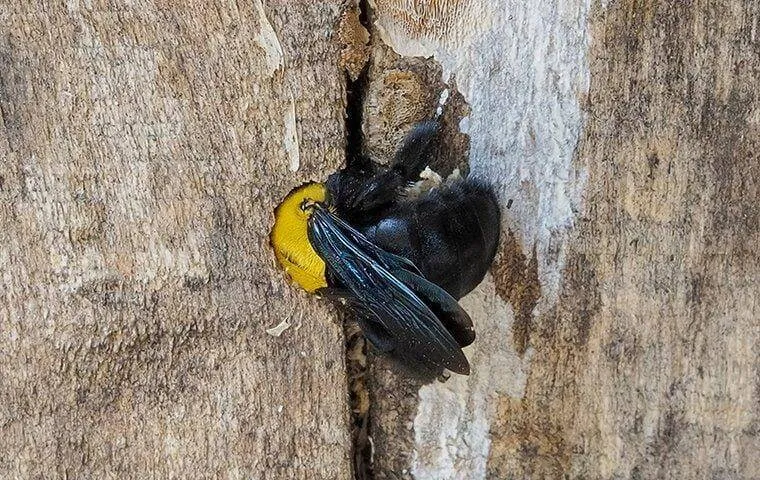
Cicada killers are among the largest wasps seen in New York. Their dark bodies, yellow abdominal markings, and low flights over lawns can look threatening, especially when several are active in one area.
These wasps do not live in one large social nest. Females dig individual burrows in bare, sandy, or loose soil and stock them with captured cicadas for their young. Males patrol nesting areas and may fly toward people, but they cannot sting. Females can sting, although Cornell describes cicada killers as unlikely to do so.
Burrows may become a practical problem beside a sidewalk, playground, entrance, or maintained lawn. In a remote area, however, their size alone is not a reliable measure of risk.
European Hornets
European hornets are large, heavy-bodied wasps with brown or reddish-brown coloring and yellow markings. Cornell identifies them as the only true hornets established in the United States. Their warmer brown coloring helps separate them from the mostly dark cicada killer.
They commonly use hollow trees, old buildings, barns, and concealed structural cavities. Colonies may contain hundreds of workers, and foragers sometimes appear around lights at night. Repeated movement near a tree opening, roof gap, or damaged section of a building may point to a nest inside.
Never seal an active opening without addressing the colony. Workers trapped inside a wall or building cavity may search for another route out, potentially moving farther into the structure.
What the Nest Location Can Tell You
Nest placement often provides a faster answer than body markings. Repeated traffic into a lawn opening suggests yellowjackets. An exposed comb beneath an eave points to paper wasps, while a fully enclosed gray nest in a tree or shrub is characteristic of bald-faced hornets. Very large wasps using separate soil burrows are more likely to be cicada killers.
Activity around hollow trees, barns, roof gaps, or wall openings may involve European hornets or yellowjackets. The New York City Department of Health’s wasp guidance lists eaves, shutters, shrubs, wall voids, attic ceilings, and underground spaces among common nesting locations.
Observe from several feet away rather than standing over an opening. Do not strike an aerial nest, insert an object into a ground hole, or block a structural entrance. These actions can provoke the colony without reaching the protected interior of the nest.
When a Wasp Nest Can Stay and When It Cannot
Not every nest requires removal. A cicada killer burrow along an unused property edge or a small paper wasp nest far from doors, seating areas, and maintenance routes may create little practical risk. The decision should depend on location and the likelihood of disturbance, not simply the presence of a wasp.
Professional help is more appropriate when a nest is underground, concealed inside a wall, high above the ground, or positioned near a frequently used area. Extra caution is warranted when children, pets, visitors, or someone with a known venom allergy may come close. Large colonies and unidentified species should not be handled through trial-and-error treatment.
Get Professional Help With Wasps in New York
By August, visible wasp activity often points to a nest that has been developing for weeks or months. Correct identification matters because yellowjackets, paper wasps, bald-faced hornets, cicada killers, and European hornets require different responses. Treating a few workers without locating the nest may leave the source untouched.
For help identifying activity or removing a nest near your home or business, turn to BHB Pest Elimination for professional wasp control in New York. You can contact the BHB team to arrange an inspection and determine the safest approach for the species and nest location on your property.